
Public Address (PA) & Intercom: IP Intercoms, Background Music (BGM), Audio-Visual (AV) Integration
Modern Public Address (PA) and Intercom systems have evolved from simple analog loudspeakers into sophisticated, network-based ecosystems. By leveraging IP technology, these solutions integrate two-way communication (intercoms), high-fidelity background music (BGM), and Audio-Visual (AV) integration into a single, scalable platform. They are designed to enhance security, improve operational efficiency, and create welcoming atmospheres in environments such as schools, hospitals, transportation hubs, and commercial buildings. Digital Home Systems Digital Home Systems +4 Key Components and Functionalities IP Intercoms & Two-Way Communication: Unlike traditional analog systems that require dedicated wiring, IP intercoms operate over existing Ethernet LAN/WAN infrastructure, enabling digital voice and video communication. Key features include: Crystal-Clear Audio/Video: High-definition video and noise-canceling audio for clear visitor verification and two-way conversations. Remote Access: Security personnel or building managers can use mobile apps or web-based dashboards to answer calls and grant entry from anywhere. PoE (Power over Ethernet): A single network cable supplies both power and data, simplifying installation and reducing costs. Public Address (PA) & Zone Paging: The PA component allows for live or pre-recorded announcements to be broadcast across the entire facility or targeted to specific areas. Software-Defined Zoning: Administrators can group speakers or adjust volumes dynamically through software, rather than physical rewiring. Emergency Voice Alarm: PA systems act as critical emergency communication tools, prioritizing safety instructions over daily announcements. Background Music (BGM) Systems: BGM is used to enhance the ambience of public spaces, such as retail stores, restaurants, and hotel lobbies. Ambience & Productivity: Calming music reduces stress in hospitals, while upbeat music can boost energy in gyms or retail settings. Noise Masking: BGM effectively masks ambient noise, making spaces feel more comfortable and less clinical. Audio-Visual (AV) Integration: Modern IP PA systems seamlessly connect with other security and facility infrastructure. VMS & Surveillance: Integration with Video Management Systems (VMS) allows cameras to automatically turn towards an intercom station when a button is pressed. Access Control & Automation: Intercoms can trigger door actuators and turn on lights, creating an intelligent, automated security flow. ZYCOO ZYCOO +9 Benefits of Integrated IP Systems Scalability: Systems can grow from a single unit to thousands of endpoints without overhauling infrastructure. Cost-Effectiveness: Reduced installation costs (fewer cables) and remote management capabilities decrease total cost of ownership. Enhanced Security: Real-time visual verification and integration with alarm systems ensure a rapid response to threats.
ELV SYSTEMS
wwahab
4/19/20265 min read
What is a Public Address System?
Public Address (PA) systems are the backbone of effective communication in diverse environments. Designed to amplify sound, they ensure messages are delivered with clarity and impact, whether for routine announcements, background music, or critical alerts.
But what makes these vital communication tools operate so effectively?
In this comprehensive guide, we will delve into the intricacies of PA systems, exploring their core components, operational principles, setup procedures, essential requirements, and diverse applications.
A Public Address (PA) system amplifies sound for a large audience.
Featuring components to control audio levels, it is used in venues like schools and stadiums for announcements, information, or live performances.
The primary goal is to ensure everyone in a specific area can hear clearly.
These systems range in complexity from a basic microphone and speaker to elaborate multi-speaker setups for larger spaces.
How Do PA Systems Work?
A PA system works by turning electrical signals into sound. It starts with a source, like a microphone or music player, which creates an electrical signal representing the audio.
This signal then goes to an amplifier, which makes it much stronger. A powerful signal is needed so the sound can travel far and be heard clearly by many people.
The amplified signal is then sent to the speakers, which convert it back into sound waves by vibrating.
These sound waves travel through the air to the audience.
To work effectively, the entire system, especially the placement of the speakers, must be set up correctly to ensure everyone can hear well.
What Is the Infrastructure of a PA System?
Public Address (PA) systems are built using either analog or digital (Audio over IP) technology.
Analog (100-220 Volt) systems are a reliable choice for sending clear audio over long distances using simple, standard cables.
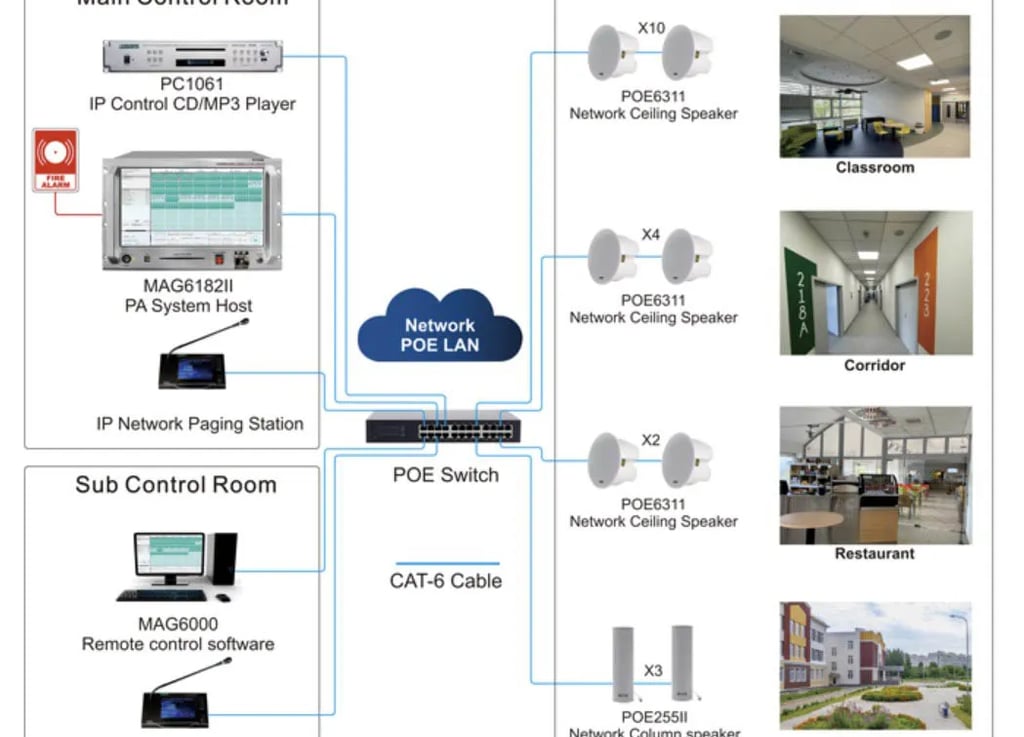
Audio over IP (AoIP) systems use modern network technology to route audio, offering advanced flexibility. They can be connected to both 100-volt and standard 8-ohm speakers.
Hybrid solutions combine the best of both worlds. By integrating IP and analog technologies, a system can connect to existing networks, work with other equipment, and be easily expanded.
This adaptability makes PA systems essential for safety, as they are commonly used for Voice Alarm System during emergencies.
Where Are PA Systems Typically Used?
Public Address (PA) systems are a familiar presence in almost every public space.
You’ll find them in places like airports, shopping malls, schools, and stadiums. Essentially any location that needs to broadcast clear announcements or music to a wide audience.
These systems are designed to be completely adaptable.
Whether for a small shop or a large arena, the system’s components, including microphones, amplifiers, and speakers, are scaled to perfectly match the size and requirements of the venue.
1. Educational Institutions (Schools, Universities)
Purpose: Daily announcements, class change bells, emergency alerts (e.g., fire drills, lockdowns), paging specific classrooms or staff, and providing sound for assemblies in auditoriums or gymnasiums.
Typical Installation: These are often zoned systems. A school can be divided into multiple “zones” (e.g., a specific wing, the cafeteria, outdoor fields, or individual classrooms). This allows an administrator to make an announcement to the entire campus or just a select area. The system is usually centralized in the main office and integrated with bell timers and emergency alarm systems.
2. Transportation Hubs (Airports, Train Stations, Bus Terminals)
Purpose: Crucial for passenger information. This includes boarding calls, gate changes, delay announcements, security messages, and emergency instructions.
Typical Installation: These are highly complex, large-scale distributed and zoned systems. Clarity and intelligibility are the highest priorities due to high background noise. They often use hundreds of speakers, powerful amplifiers, and sophisticated digital signal processing (DSP) to ensure messages are clear everywhere. Many are integrated with automated announcement systems that use text-to-speech technology for standard messages.
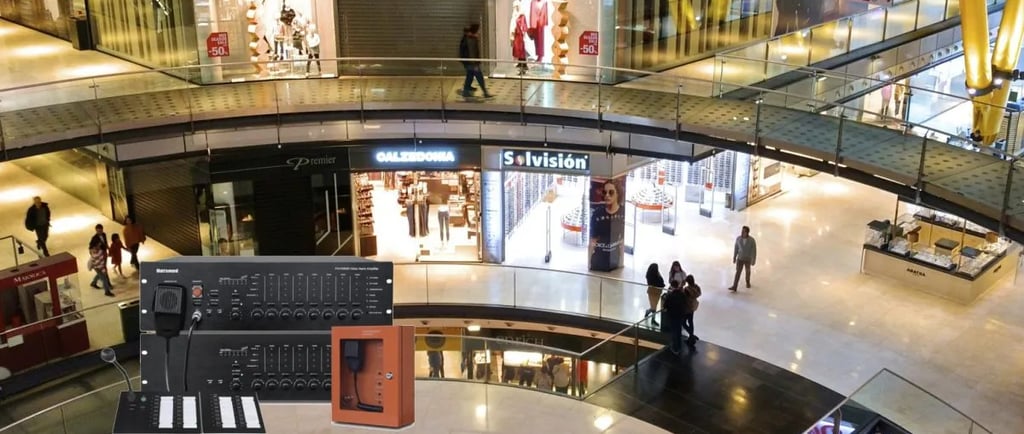
3. Retail and Commercial Spaces (Shopping Malls, Supermarkets)
Purpose: Background music (BGM), in-store promotional announcements, paging staff, and public safety announcements (e.g., “lost child” alerts).
Typical Installation: These are classic distributed audio systems, often using many small ceiling speakers to provide even, low-volume sound coverage across the entire space. The goal is consistent audio that is pleasant for BGM but can be clearly heard when an announcement is made.
4. Entertainment and Sports Venues (Stadiums, Arenas, Theaters)
Purpose: Announcing plays or scores, playing music to energize the crowd, providing information, and directing large crowds during an emergency. In theaters and concert halls, they function as high-fidelity sound reinforcement systems to ensure every seat hears the performance perfectly.
Typical Installation: These require high-power, large-scale systems. Stadiums and arenas often use large speaker clusters or line arrays designed to project sound over long distances to thousands of people. Theaters use precision-engineered systems focused on acoustic quality and fidelity.
PA Systems Q&A
1. What are public address systems?
Public address systems are integrated audio setups designed for broadcasting announcements and ambient music. They typically consist of a central amplifier connected to several speakers and are commonly installed in commercial, educational, and industrial settings like stores, schools, and factories.
2. What to look for when buying a public address system?
The right system depends on your specific needs. Key factors to consider include the number and type of speakers required to cover your space, as well as the audio inputs you’ll need (e.g., Bluetooth, microphone, AUX). The best choice will match the size of your area and its intended use.
3. Are ceiling or wall mounted speakers better?
Neither is universally better; the choice depends on the application. Ceiling speakers are excellent for providing discreet, even background music in indoor environments like offices or restaurants. Wall-mounted speakers project sound more powerfully and are better suited for larger, open areas where higher volume levels are required.
4. What is mic priority?
This is an automatic audio-ducking feature. When someone speaks into a connected microphone, the system automatically lowers the volume of any background music. This ensures that spoken announcements are always clear and easy to understand over any other audio that is playing.
5. Does more watts mean louder?
Not necessarily. While wattage indicates power, a speaker’s loudness is also determined by its efficiency and build quality. A high-quality, lower-wattage speaker can often sound louder and clearer than a poorly made, higher-wattage one. The physical size of the speaker is also a key factor in its volume capability.
6. How do public address systems work?
A central amplifier serves as the system’s heart, powering a network of connected speakers. Many systems utilize a 100V line architecture, which simplifies the process of wiring many speakers in a series (daisy-chaining) over a large area. The amplifier also functions as a control hub for managing various audio sources and adjusting their volume levels.
7. What types of public address systems are there?
Systems are typically categorized by their installation environment. The most common types feature ceiling-mounted speakers for subtle indoor sound, wall-mounted speakers for more robust sound projection, and specialized outdoor systems that use weather-resistant speakers, including horn-style models for maximum projection.
8. Do public address systems have Bluetooth?
Bluetooth connectivity is a standard feature on most modern public address systems, allowing for convenient wireless audio streaming from smartphones, tablets, or computers. However, because it is not universal, it is always best to verify that this feature is included on the specific model you are considering.
9. Do I need a public address system?
If your business or facility requires a method for both playing background music and making clear verbal announcements to customers or staff, then a public address system is an essential tool. It provides a reliable and centralized way to manage all your audio broadcasting needs.
10. Can I use a public address system for live music?
No, this is strongly discouraged. These systems are engineered specifically for background-level audio and speech. They cannot handle the high power demands and wide dynamic range of live music from a band or DJ. Attempting to do so will likely result in poor sound quality and could permanently damage the speakers.
At Proact, your success is our purpose
© 2025. All rights reserved.
Contact
Phone: +201031314664
Email: sales@prosys-eg.com
Address: Mokattam, Cairo, Egypt