
Transforming Security with IP Surveillance, Analytics, and Thermal Imaging
In the rapidly evolving world of Extra Low Voltage (ELV) systems, the "heartbeat" of modern security is no longer just about recording video—it's about active intelligence. At ProAct Technology Egypt, we are witnessing a paradigm shift where traditional surveillance is being replaced by integrated, high-definition ecosystems that see what the human eye cannot. From high-resolution IP Cameras to the invisible power of Thermal Imaging, here is how modern technology is redefining safety and System Integration.
ELV SYSTEMS
Anonymous
4/16/20264 min read
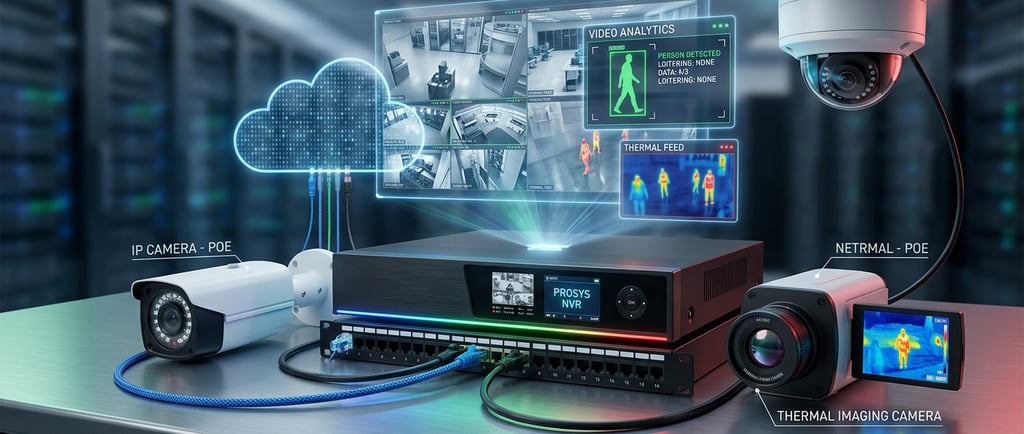
CCTV & Surveillance: IP Cameras, NVR (Network Video Recorders), Video Analytics, Thermal Imaging
Closed-Circuit Television (CCTV) is a system in which images are monitored and recorded for surveillance and security purposes. Though still in general us, the acronym 'CCTV' is now outdated, as this refers to the hard-wired analogue cabling approach which has generally been replaced by digital Video Surveillance Systems (VSS) that operate over TCP/IP networks. Analogue CCTV systems are still available and, if it suitable for your requirements, can still provide a viable and cost effective option, particularly for small installations.
For simplicity, CCTV will be used throughout this article.
It is important to understand that CCTV will not prevent criminal action, but may deter, or detect a criminal action. CCTV should always be used alongside other security measures to provide a coordinated security solution.
Site CCTV systems are generally deployed to achieve the following functions:
Deter an attempted intrusion by causing an adversary to reconsider the site due to enhanced probability of detection.
Detect an attempted intrusion to the site using video analytics.
Verify and further investigate and alarm event from a Perimeter Intruder Detection System (PIDS).
Tracking of an intruder when they have breached the perimeter.
Recording of digital image evidence suitable for use in an investigation or court proceedings (see guidance below for retention policies).
Overlooking Access Control area
The term Video Surveillance Systems covers a wide range of technology, which can include:
Visible band camera sensors.
Infrared band camera sensors.
Thermal imaging sensors
Video analytics and content analysis.
Static cameras with fixed/varifocal lens.
Pan, Tilt, Zoom (PTZ) cameras.
Panoramic/360*/180* cameras.
Active Infrared Cameras
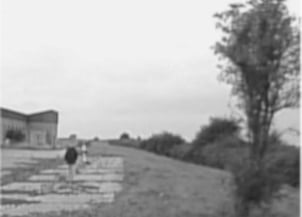
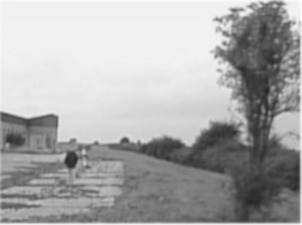
A camera with active infrared lighting is designed for low light environments and uses integral infrared LEDs to spread IR light over the scene. IR light is not visible to the human eye. This IR light is reflected to the camera sensor and interpreted to generate a usable image within the Greyscale (black and white) color spectrum. The image produced within the IR lighting parameters, will not provide color definition, for example - a red jacket will appear dark grey or black. The viewed image is not black and white as per the normal understanding.
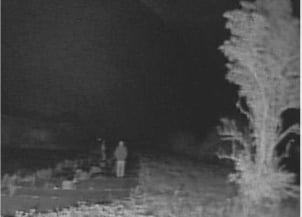
The monochrome (black and white) image shows the tree as a darker shade and the person wearing a dark coat
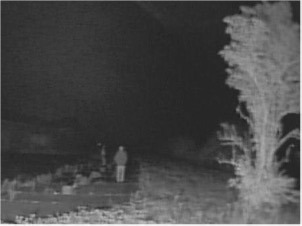
The Infra-red image shows the same tree as a light color and the person in a lighter coat
In many cases, the integral IR LEDs within the camera will not be adequate to illuminate the scene sufficiently. In this case, supplementary IR lighting should be installed to assist the camera in achieving a good quality image.
Active infrared cameras are useful where the operator needs to see more detail in low light situations, such as identifying or recognizing a person.
Thermal Imaging
Thermal imaging camera technology uses mid to long wavelength IR energy. Although the term camera is often used with thermal imaging, the devices are, in fact, sensors. Thermal imagers are passive and will only sense differences in heat, not light as with standard cameras. These heat signatures are then displayed within the image. This type of camera technology is primarily used for detection and is ideal for use on a site perimeter where the focus is detection of attempted intrusion.
As thermal imaging sensor technology operates in longer infrared wavelength regions than active IR, they do not see reflected light, and are therefore not affected by rain, fog, smoke, haze and dust. This makes them highly effective in perimeter monitoring over long ranges.
Thermal cameras monitoring a perimeter should be placed so their fields of view run parallel to the perimeter and perpendicular to the movement of potential intruders to ensure targets move horizontally across a camera's field of view. This design approach results in the highest probability of detection and the lowest rate of false alarms.
Thermal imagers can be used to determine the class (vehicle, person, animal) of a target, but will not allow an operator to identify the person, or the colour of a vehicle.
It is important to note that thermal imagers cannot see through glass, as the glass acts as a mirror for infrared radiation.
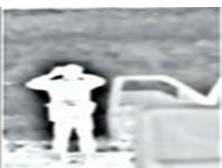
This thermal image shows a person using binoculars. Note that the partially rolled down window allows the background to be seen through the open portion only. The glass blocks the image. The person is clearly visible and can be seen to be wearing equipment at their waist
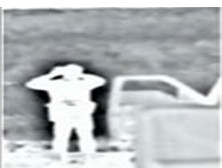
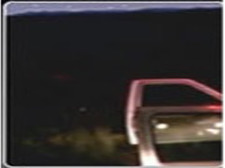
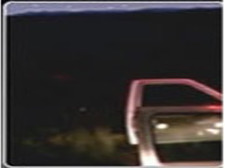
This is the same image captured using a visible band camera. The person is not visible at all, and the background is very dark. However, the car's interior light allows much greater definition of the car door.
Video Analytics
Video analytics is a technology that processes video signal using specific algorithms in order to perform a task or function. They are a way of using machines and software to understand the scene in real time or in retrospect. The primary aim of video analytics is to make detection more accurate and reduce the burden on the operator.
There are many uses of video analytics which include, but are not limited to:
Identifying items left behind
Sterile zone detection
Anomaly detection
Automatic number plate recognition
Tracking
Video analytics may also be used retrospectively, for example by police when reviewing CCTV imagery following an incident.
At Proact, your success is our purpose
© 2025. All rights reserved.
Contact
Phone: +201031314664
Email: sales@prosys-eg.com
Address: Mokattam, Cairo, Egypt